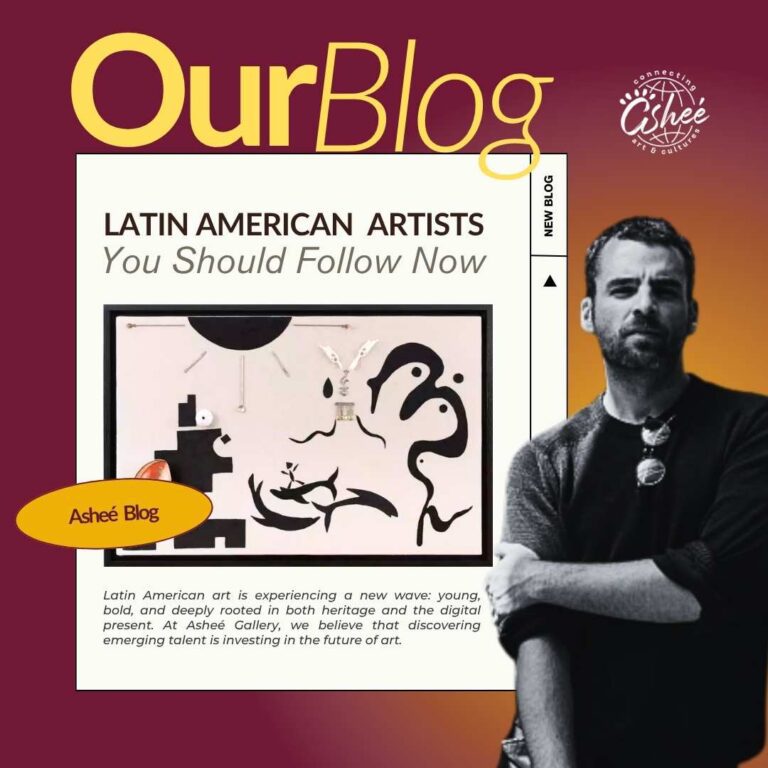
Latin American art is experiencing a new wave: young, bold, and deeply rooted in both heritage and the digital present. At Asheé Gallery, we believe that discovering emerging talent is investing in the future of art. Here are five names redefining the scene:
- María Conejo (Mexico) – With an intimate and powerful line, she explores the relationship between body, identity, and contemporary femininity.
- Andrés Pereira Paz (Bolivia) – Fuses Andean mythology and political critique in installations that dismantle colonial narratives.
- Daniela Ortiz (Peru/Spain) – Her work blends activism and performance to expose structures of power and exclusion.
- Adriana Minoliti (Argentina) – Through digital painting, she creates queer, geometric worlds where color becomes language.
- Diego Machado (Brazil) – Between urban muralism and digital graphics, his work refreshes Brazilian modernism with a contemporary twist.
Different in technique but united in intensity, these artists confirm that Latin America remains an inexhaustible source of visual innovation.
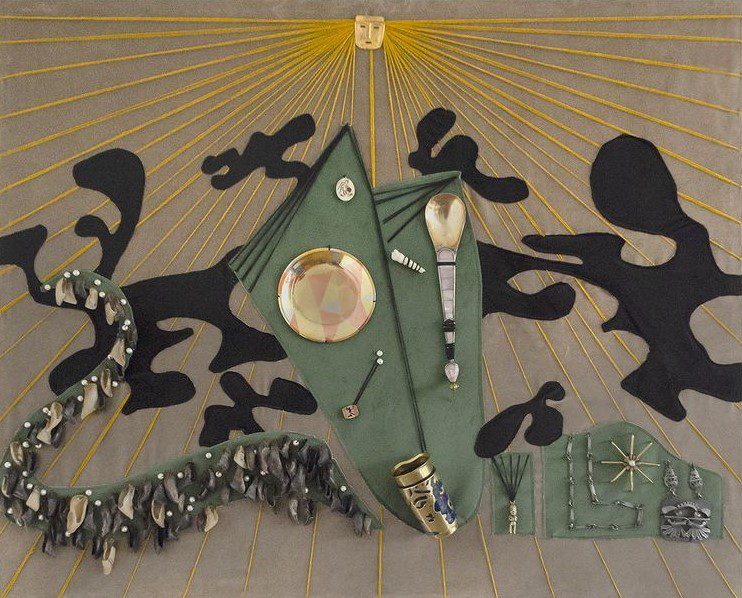
Andrés Pereira
Misterios: Amaru (navegar por múltiples dimensiones), 2022
Tapestry embroidered with objects from the workshops ‘Los Castillo, Joyas de Tiahuanacu, Salvador Terán and others’
120 x 150 cm.
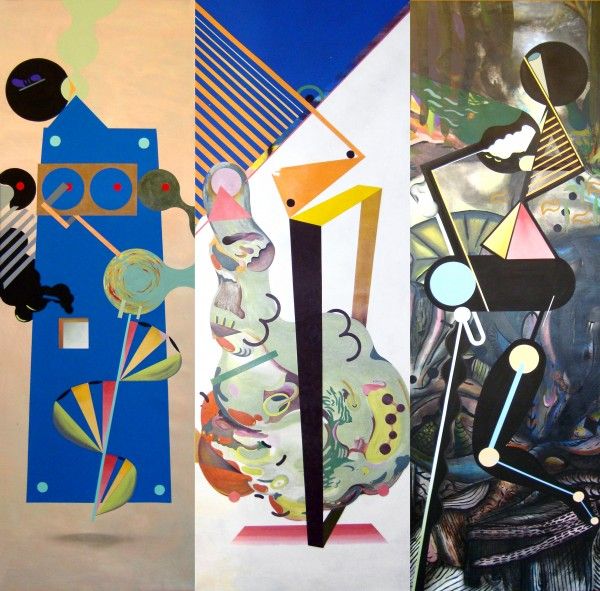
Adriana Minoliti
Tríptico, 2010
Oil, acrylic and enamel on canvas
210 x 70 cm each one.
Surprising Similarities Between Pre-Columbian Art and Contemporary Swiss Design
At first glance, they may seem worlds apart—one ancient, the other minimalist—but Pre-Columbian art and Swiss design share more than you might think:
- The power of the symbol: From Andean textiles to Bauhaus or Helvetica logos, geometric form conveys pure meaning.
- The pursuit of balance: Maya or Moche ceramics show mathematical precision comparable to Swiss composition—nothing is missing, nothing is superfluous.
- Aesthetic functionality: In both cases, art is not mere ornament but an extension of daily life—be it a ceremonial vessel or a typographic poster.
This affinity reveals that cultural distance can be deceiving: beauty, when born of coherence, speaks a universal language.
The Colors of Latin America and Their Meaning in Art
Color in Latin American art is not mere decoration—it is language, emotion, and history. From Frida Kahlo’s deep blues to Cruz-Diez’s vibrant yellows, the continent’s palette tells centuries of blending and resistance.
- Red: passion, blood, life—but also protest.
- Blue: spirituality, the sea, introspection.
- Green: enduring nature, a symbol of hope.
- Yellow: light, energy, tropical vitality.
Artists across the region use color as a manifesto: each stroke evokes identity, memory, and a desire for transformation. At Asheé Gallery, we celebrate this chromatic force that makes Latin American art a full sensory experience—capable of illuminating any space.